The Path of Mankind`s Woe

On the 8th March 1908 the Dutch writer and psychiatrist Frederik van Eeden outlined his philosophy in a speech at Carnegie Hall. He made a bold declaration, claiming that utopia was not just admirable in theory but evidently possible in practice. He was a learned and respected man, but seemingly unfamiliar with the niceties of political and economic theory.

He was renowned as a visionary and idealist, maintaining that humanity could not continue to survive through the pursuit of money. Instead he advocated a philosophy which now sounds extreme and unrealistic. He was convinced that people could be persuaded into living a purely ascetic and altruistic life. He thought that happiness was a state of mind only realised through selfless dedication.

In one of his famous moralistic essays he stated,

“Where mankind is, and her woe, there is my path”.

Dr. Van Eeden`s motivation for utopian societies derived from the often intractable problems endured by his patients. Many of them were afflicted by trauma, addiction and insurmountable depression.

Van Eeden opined that a world driven by materialism neglected the spiritual needs of its population. He established his own version of utopia in his native Holland, in a town called Bussum in the north of the country where the residents produced their own food and shared all of their goods. They also chose to eschew any luxury or comfort, as their lives were only dedicated to the well being of each other.

The community at Bussum was designed to resemble the self-sufficient dwelling of the American writer Henry David Thoreau, who famously built a hut in the wilderness of Massachusetts. However Thoreau`s dream project was only realised through private funds. The money question is the central dilemma obstructing the development of any utopian society. Also other questions arise whenever anyone suggests alternative communities. Many people would feel uncomfortable if they were forced to sacrifice their familial or individual identities.

Utopia literally translated means “nowhere place”. It is apt that the literal definition clashes with the ideology. Wealth has to be generated and earned to fund other people’s lifestyle choices. Not one innovation has been created in societies where the wealth is controlled by the state.

However many thinkers from the late nineteenth century onwards only saw the iniquities embedded within materialist societies and dreamed about alternative ways of existing. They lacked sufficient foresight to perceive the pitfalls of communitarian societies, and enthused lyrically about their vision of this mythical paradise.

In 1890 the British artist and writer William Morris wrote a fantasy novel on this subject. It was called “The News from Nowhere” and it imagined a socialist utopia. In Morris` fantasy there is no hardship, nor any crime because the only driver in this society is to do good to others. It now seems ridiculous to modern readers that such a sanitised version of reality was presented, and that Morris envisaged a set of flawless characters that appear hollow and barely human.

Van Eeden died in Bussum in 1932. Even in his later years he never stopped believing in the potential goodness of all human beings. His belief was admirable, but impractical. However the Bussum example has been proven to be a useful template in treating troubled individuals and has paved the way for future therapeutic communities and for this we must be thankful.

Dangerous Minds

On March 1st 1940, the African American author Richard Wright published his novel “Native Son”. It was a book that gained both instant attention and notoriety. Owing to the contentious subject matter the writer’s intention was widely misunderstood by critics.

It is a book about the short and tempestuous life of a young African American man called Bigger Thomas. Thomas is deliberately painted as a morally ambiguous character, his existence is neither romanticised nor patronised.

Thomas is born into an atmosphere of poverty and oppression. As he grows older he is increasingly frustrated by his lack of education and opportunity. He becomes an aggressive bully and a misogynist, and in the closing chapters he is sentenced to death for rape and murder.

Wright`s narrative details how the inchoate rage that burned in the opening chapters tempers into self pity and he solemnly accepts his fate. Many of Wright`s contemporaries loathed the book and castigated him for his stereotypical portrayal of a black man. However Wright sincerely believed that he was just representing the realities of a violent and prejudiced society.

It is uncomfortable to confront reality in its unvarnished state but the most profound pieces of art focus on the darker episodes of human experiences. Bigger Thomas is a fictional character in a work of literature, but other representations of this character have filtered into popular culture.

Tupac Shakur was a real person who had lived experience of poverty and oppression but in many ways he had greater educational and artistic opportunities in 1990s America than the writers of Wright`s generation. Shakur was initially a performing arts student with prodigious talents in acting and music, but grew up in the shadow of real danger as the son of prominent Black Panther activists. He was under the radar of the police authorities since his birth.

When Shakur was in his late teens he moved from New York to California to explore a career in rap music. Shakur was distinct from other rappers of that era, as his college education meant that his material was fiercely articulate. He was conscious of issues like police brutality and street gangs. His stage persona was unlike the shy bookish young man that he really was behind the scenes.

However his alter ego was nihilistic and anti-social, an artistic rendering of the “thug” that so many people feared or respected depending upon his audience. It was also an image that was extremely lucrative but had sinister implications when art began to blur into reality. Shakur was arrested numerous times for misdemeanours, before ending up in jail for sexual assault.

Shakur maintained that the incident involving a female fan was a consensual encounter, but there were suggestions that alcohol and drugs had blurred his judgement and admitted there were times when he was guilty of extreme chauvinism but never violence.

Shakur was serving his sentence when a rap label run by a shady individual called Suge Knight offered a deal. In exchange for bail he gave him a recording contract. Knight had known connections to real gangsters.

Shakur felt that he had no choice but to accept Knight`s offer. But his experience of incarceration had changed him, and he wanted to use his music to transcend the caricature of the thug. Still his reputation for rattling conventional society never left him and he was shot dead in suspicious circumstances.

It is a sad reflection of society that bright, young artists can be manipulated by opportunists and then die in circumstances beyond their control. It is also tragic that we are still having the same arguments about racial stereotypes in art and we haven’t really learned anything since Richard Wright started the conversation back in 1940.

Offa’s Curse

In 1867 the English writer Matthew Arnold expressed a series of powerfully pertinent observations about the original people of England, our forebears. He proclaimed that just because there is no trace of their original culture after the Roman and Saxon invasions it does not mean that as a people they have never existed, or that their memory and legacy does not impact upon us today.

Indeed conquerors make their own history but the vanquished are forced to suffer in silence. There are no documents in existence that suggest genocide occurred, or that the native inhabitants were forced into exile. Many survived the invasion, remained in the country and absorbed the language and customs of the invaders, but others clung to older traditions.

One of the most important traditions was what Arnold defined as our “natural magic”. He celebrated our ancestors “passionate, turbulent, indomitable reaction against the despotism of fact”. The Romans may have brought a semblance of sophistication to a country which to them seemed savage and barbarous, but the conquered peoples found a greater meaning in their past existence.

Although it was a harsh existence dominated by chaos it was believed that it was destiny, and entirely a consequence of the whims of the supernatural deities. Many of our superstitions derive from that mysterious period of our history and continue to emanate in our culture. Most superstition stems from ancient folklore.

The folklore that surrounds pagan figures like witches is very old. Evidence suggests that it dates back to the Neolithic era. The distinctive spiral patterns carved on burial sites suggest that there were spells invoked to secure a good afterlife for the departed.

Concepts like lucky or cursed animals are also very ancient, but still hold sway in our modern times. This is evident by fears about giant black dogs roaming the countryside, or the superfluity of natterjack toads.

When anything unexplained or mysterious happens, there is still a temptation to delve into this fantastical realm to assuage our fears. Imagination is very powerful, it can challenge conventions but when all rationality dissolves civilisation will perish.

Paragon of Animals

Traditional science promotes the view that mankind has evolved as a superior species owing to our prodigious skills in communication. However other species of animals are evidently sophisticated in terms of language and organisation.

I believe that it is too presumptuous to continue to believe that humans will dominate this planet until infinity. A recent study from Cornell University has revealed that fish are surprisingly adept with language. Scientists have published an illuminating paper that states that even the smallest fish can use sound to communicate, and this allows them to organise their behaviour. This fish language has enabled them to form and perpetuate their own unique societies.

Other animals have evolved in more compelling and mysterious ways, for example the domestic cat has developed quite distinctly.

This form of animal is not quite tame and not entirely wild either. It has an instinct to survive even in the most challenging situations but knows that it has an innate capacity to charm and cajole humans for its needs.

Cat intelligence is far more sophisticated than humans, and we should give them credit for that, instead of maligning their perceived amorality. It is in fact humanity that needs to question its own notion of morality as it appears to fight against the natural world rather than adapt to it.

Human intelligence and humans` unique sense of moral superiority helped to build the world. Now we are only succeeding in destroying it, not just our environment but ourselves. Our supposed advancement has led to a shocking decline in our health and well being as the natural world that has sustained us over millennia is dying.

Pierre Boulle was acutely aware of this as early as 1963, when he published his novel “Planet of the Apes”. This was a clever and witty twist on the theory that humans evolved into a superior species, in contrast with the inferior, knuckle dragging apes that preceded them.

In Boulle`s fantasy, the humans are inferior to the apes and are subject to all of the abuses and humiliations that animals face on a parallel planet. The book also highlights uncomfortable truths like the ethics of animal experimentation and it was one of the first books to highlight the modern theory of “speciesism” . This is the theory that centres upon human prejudices against animals and challenges human supremacy.

Boulle had an insight into the experience that animals face at the hands of humans. He could perceive the innate dignity of individual animals and understood their intellectual capabilities. I believe that once the final human being dies on Earth, a greater animal civilisation will be built.

We Are Nothing

Throughout history humanity has struggled to define the difference between the “we” and the “I”. Humans are indeed unique yet baffling creatures, simultaneously social but driven by individual ego. Consequently major battles have been fought and innocent people have died to give succour to the vain egos that appear to run world affairs.

The struggle for the “we” is often a noble one, an attempt to find unity and commonality in a diverse world. However every single attempt to achieve this has proven to be oppressive and deadly. Similarly the struggle for the “I” has had noble intentions as it derives from a need to assert individuality where conformity has crushed dignities and aspirations. However overt individuality leads to behaviours that are unkind and antisocial, and can if unchecked destroy communities.

Ayn Rand was a writer and philosopher who exemplified modern western capitalist notions of individuality. She believed in ambition, responsibility and freedom but castigated despondency, dependence and repression. She was familiar with political systems that kept people in undignified servitude as she was a Russian refugee but determined to succeed as an American citizen.

In her dystopian novella “Anthem” every citizen has been stripped of their individuality. They are reduced to mere numbers, their rich cultural history has been erased and they are forced into demeaning work in factories until they are sent tired, ill and demoralised to state institutions where they reside until death.

However one person is strong enough to realise that individual life has meaning and that people are not machines in a state apparatus. Her version of “ego” is strictly metaphysical rather than pejorative, in that every human is a conscious thinking subject.

Frank Herbert also pondered this subject in his series of “Dune” novels. He contrasted the experience of conscious thinkers striving to exist in a desert empire dominated by religious fanaticism. The only reason why this society remains successful is due to the wealth generated by a resource called “spice”.

However this is an empire riven with division, wars are continually waged between rival factions. The quest to acquire complete homogeneity is always at the expense of the personal freedom of individuals and it is a life fraught with misery. Dune is an allegory that alludes to the historical religious and political struggles between Eastern and Western traditions. These struggles were painful and unfortunately still resonate today.

It remains a fine balance to honour the virtues of having profound religious beliefs while respecting the dignity of individuals who seek their own path and wish to find unique meaning in their lives.

Not Angles, Just Angels

Twenty-first century England is entirely different to the traditions and culture of its past. It appears that in the haste towards modernity our precious values have been lost. We used to value the past and our connection to it, but now a nihilist and self destructive ideology has rendered that value obsolete.

English people used to be deferential and reserved, but instead a culture of coarseness and arrogance has imbued the nation. It is a consequence of the political climate at the moment, but trampling over tradition and inheritance isn`t new. England was originally an uncultivated landscape, then it developed into a rural and farming society until industry replaced the old ways.

However as we transitioned into a manufacturing nation we were richer materially but gradually grew poorer spiritually. The North and the Midlands were transformed by mills and factories but this was at a cost. Emily Bronte`s innocent vision of Bradford with its “benign sky” and “quiet earth” was vanishing, instead the skies were clouded by the imposing towers of industry and the mechanical noise of the looms. Soon people began to lose their spiritual connection to the land.

Every modern political and social movement seeks to distance itself from the past. As the twentieth century approached there was a feverish anticipation for the new coupled with a desire to divest with the old. Twentieth century English people grew more cynical of religion and community, and more enthusiastic for materialism and individuality. London was the focal point for this new philosophy. However modern Londoners themselves seemed to be oblivious of the torrid history of the city.

London was a place of violent colonialism and genocide, it was invaded and occupied by the Romans, until the indigenous Iceni tribe rebelled in AD 61. A valiant war was waged against their imperial oppressors but the Roman might was too great and the Iceni were wiped out. The remains of the Iceni martyrs now reside at the site of the Angel tube station. As this is the only memorial to their courage and sacrifice it seems grotesque, a flashing neon sign instead of a gravestone.

London, along with Birmingham and Coventry was nearly obliterated during the Second World War. The War was eventually won, but those things of beauty, the priceless architecture and landscape remained lost forever. Virginia Woolf was a champion of modernism and the fiercest critic of the Victorian age, but when she witnessed the devastation wrought by war she believed that her forebears sense of tradition was something worth preserving and honouring.

The Second World War was the apotheosis of modernity and the herald of a darker age. Cities needed to be rebuilt, but the architects of the fifties and sixties were stubbornly devoted to notions of progression and unconcerned with restoring the past. The results of this obstinacy are all around us, bleak tower blocks, car parks and motorways.

Motorways continue to remain a dreadful blight, as Peter Hitchens opined only last Sunday that “in our small, beautiful landscape and our ancient, intimate towns there never was any place for these rivers of angry steel, snarling and growling through once serene hills and fields..pouring filth and noise.” Hitchens is now a septuagenarian but younger generations in this country will never remember that we used to live in a pre industrialised, green and pleasant land.

Younger people are led to believe that England has always been a place of brick and concrete, and that materialism has been the sole and prevailing ideology. Now we are almost permanently disconnected from our own history, and staring into a future which is hollow and meaningless.

Wolves At The Door.

The last English wild wolves were believed to have been hunted into extinction around four centuries ago. In those times wolves posed a great threat to other animals and sometimes to people, but were often misunderstood.

However their reputation as the ultimate predator became part of folk history. In spite of their fearsome reputation they were also respected and this helped to create a mythic literary tradition which we still draw upon today.

The first English saint, St Edmund was believed to have been visited by a wolf after his murder. While battling Northern interlopers in his Anglian kingdom he was killed through decapitation. In the legend the wolf guarded his head until the rest of his body was found. This helped to seal the wolf`s reputation in our culture as a fiercely loyal and courageous animal.

In other cultures around the world legends surrounding hybrid animals are invoked in times of political crisis, civil unrest and when citizens feel that their identity and sense of morale is under threat. The wildest and most ferocious creatures are imagined as a means of gaining control over their own feelings of powerlessness. Russian folklore focuses upon the strangest and most frightening beasts.

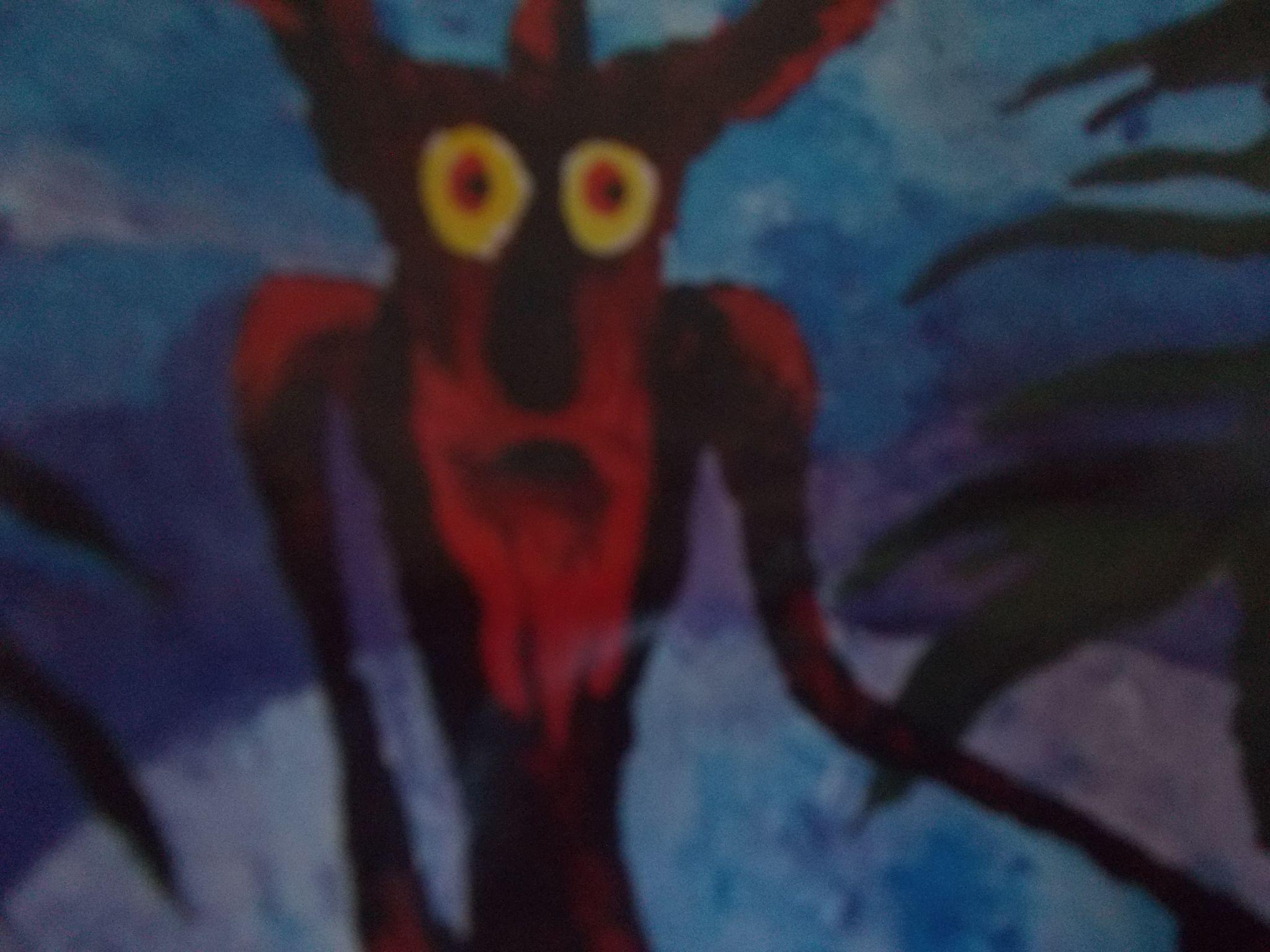
(Drawing by a Russian child of Shurale, a mythic beast from Tatarstan, a province 500 miles from Moscow).

The Shurale was a wildman figure that was part monster and part ape, and blamed for numerous crimes including horse theft. His barbarian nature was feared but also strangely revered in a society that was wracked by division.

Shurale took many forms and inspired other creatures throughout Russian history. In the aftermath of the Russian revolution, frightening stories about demons and cannibals imbued the national consciousness.

In James Meek`s epic novel of this revolutionary period, “The People’s Act of Love”, a wise character observes,

“He’s not a destroyer, he is destruction, leaving those good people who remain to build a better world on the ruins. He is the storm the people summoned, against which not all good people find shelter in time.”

In our modern world we are far too cynical, and perhaps too comfortable to dwell upon myths and legends. Modern people forget that our ancestors were often hungry and afraid. Ancient people relied upon superstition to explain a precarious existence. They lacked scientific knowledge and coherent political strategy, but they had something which we yearn for now, a belief in spirituality and awe for powers that are much greater and stronger than our fragile human egos.

Thrones and Dominions

The American writer and philosopher Ralph Waldo Emerson once opined that,

“The two parties which divide the state, the party of Conservatism and that of Innovation, are very old, and have disputed possession of the world ever since it was made. This quarrel is the subject of civil history. The conservative party established the reverend hierarchies and monarchies of the ancient world. The battle of patrician and plebeian, of parent state and colony, of old usage and accommodation to new facts, of the rich and the poor, reappear in all countries and times. The war rages not only in battlefields, in national councils and ecclesiastical synods, but agitates every man`s bosom with opposing advantages every hour.”

Emerson`s prophetic words seem especially acute in the current political and social climate. The voices that advocate for conservatism are often met with a fevered denunciation by the voices that clamour for revolution. The former cling to tradition and order, whereas the latter seek modernity and necessary disorder.

We understand this philosophical schism in broad terms as right versus left, which originates from revolutionary era France. At that time the monarchists sat on the right side of the parliamentary building and the radicals sat on the left. The left wing revolutionaries believed that disorder was necessary to recreate their modern vision of how society should operate. However those on the right were more religious and desired a certain level of continuity with the old orders and hierarchies. The left believe that they were vindicated as revolutions deposed old rulers in return for some semblance of freedom. The right believe that this freedom has come with a heavy price, and simply replaced one form of oppression for another.

In truth no system is perfect. It is a natural human desire to seek individual fulfillment but also to participate in a functioning society. Pure individualism leads to selfishness, avarice and cruelty. An overbearing conformist state just crushes individuality and ultimately condemns people to an unending cycle of poverty.

Throughout history it seems that every single attempt to correct human society through political means has ended in misery and death. It is impossible to fashion heaven on earth, to force people to behave equatibly while simultaneously divesting those things that make us individually human. It is a laudable aim to improve humanity, but humanity is flawed. The only meaning that we can possibly derive from all of this is that there has to be something greater than humanity that awaits us.

In My Father’s House

On the 8th December 1982, the Colombian writer Gabriel Garcia Marquez delivered his speech to the Nobel committee who had awarded him that year`s prize for literature. It was called “The Solitude of Latin America” which alluded to his magnum opus “One Hundred Years of Solitude” and also focussed upon the themes that inspired his singular work. He argued that Latin America had a unique history which was often neglected by the wider world.

His novels read like wild flights of fantasy with little resemblance to the real world, but Marquez insisted that his fiction was a reflection of the strange and magical figures that shaped the continent. One familiar character that reoccurs in his novels is the dictator. Dictators were unfortunate features of the postcolonial world.

In Marquez`s milieu these often deluded patriarchs wield almost supernatural powers over a demoralised and beaten populace. The Spanish dominated and ruled over central and southern America for three centuries. In the wake of their retreat a series of revolutions and counter revolutions occurred, creating a bloody atmosphere of near pandemonium. Mexico, for instance, was historically a tempestuous country.

The Mexican people endured lengthy periods of violent instability, before and after Spanish colonisation. Before colonisation they developed legends and superstitions and venerated patrician talismans. After colonisation Catholicism was absorbed into society but it was infused with these older, polytheistic beliefs.

In this fevered atmosphere it was easy for narcissistic dictators to win the trust of a nation. These dictators cultivated a paternalistic style of government and were experts in manipulating the religious sentiments of the population. General Antonio Lopez de Santa Anna was one of Mexico’s most notorious dictators.

The General was a shameless opportunist but was still revered as a messianic style figure by most of the country. When he lost his leg in a battle against the French he made a demand that it should be preserved as a relic, and later interned in an elaborate funeral ceremony. This unbelievable demand was granted.

The ceremony went ahead in Mexico city. It must have been an extraordinary sight to witness this huge religious procession attended by military dignitaries where a leg (sealed in a crystal urn) was buried in a plot decorated with the Mexican flag. This was just one example of how he managed to create his own image as a nationalistic and religious cult leader.

However there were older Mexican traditions that now seem gruesome to modern western people. One Mexican figure was so revered by his courage in battle that his followers wore parts of his flayed skin, partly as devotion but mostly to ward off evil.

These fantastical stories imbue the work of Marquez and illustrate how societies in flux seek populist leaders. Tragically there are many countries that still succumb to the promises of men with obvious delusions of grandeur. It seems that even in the so-called civilised world people are reduced to a child-like level of thinking and elect leaders presenting themselves as saviours and fathers, when in fact they are egoists with self serving interests.

Death of the Imagination

England should be respected and revered as a land of great majesty, a scrap of earth in the middle of a tempestuous sea that has weathered times of great hostility since its creation from the tenth century. Instead it has inspired cynicism, contempt and condescension for everything including its traditions, its people, even its climate.

However it isn`t foreigners who are responsible for all of these attitudes, but the English themselves. In fact it is a particular group of English people, who are affluent and supposedly educated who turn their noses up at English culture. These are the same people who heap praises upon other European nations, professing the superiority of the music, religion and weather in these countries.

There is a kind of dullness associated with these people who cannot appreciate the beauty of their own nation, who fail to be moved by an Elgar concerto, by the words of the Book of Common Prayer, or by the dark tones of a winter morning so perfectly evinced within a Turner painting.

These dull critics believe that they are liberal minded and identify with that nebulous concept of being “European”. Consequently the erasure of English pride and identity has accelerated, as these are the privileged voices that dominate.

Alongside this has been a corresponding decline in imagination. There has always been a strong thread of philistinism running through our society which has looked down upon anyone prepared to be creative or unusual. Unfortunately many of our artists have had to seek refuge in other countries where they are understood rather than mocked or ridiculed. Ironically most people from European countries have a deep admiration for English culture.

The writer John Higgs has written extensively about the life and work of William Blake. Higgs has observed that Blake is loved by disparate English men and women, from tweedy aristocrats to youthful punk radicals with coloured hair. It is remarkable that no other English poet attracts so much adoration from people who have so little in common. Nonetheless he was derided in his lifetime, lived in penury and castigated as mad and dangerous. Then, as now, the establishment and wider society were suspicious of someone who was different and imaginative.

Blake could not be more English in his references to nature and character, but as conformity is so entrenched within our society he was misunderstood. The political and cultural establishment in this country continues to inhibit free thinking from creatives. Other countries respect this, regardless of how uncomfortable this may be. Higgs describes making a pilgrimage to Blake`s birthplace in London, but to his dismay all he finds is a cake shop, the kind that you find on every high street in this country along with Marks and Spencers and other chains. He also complains about the well heeled but stubbornly provincial residents of Primrose Hill who objected to a plaque dedicated to the eighteenth century druid and poet Iolo Morganwg. The plaque was unveiled on the hill to commemorate this island`s distant druid past and Bardic tradition, but the residents were too dull and suburban to appreciate it.

Higgs addresses this strange disdain that some people have for our national poets and by association our nation directly,

“A sense of connection to your land, it can be argued, is necessary for, not opposed to, a deep respect for people of all cultures and creeds. This position goes past the framing of nationalism and internationalism, or leave and remain, as our primary duality. Instead it divides the world into those who delight in what they love, and those who focus on what they hate.”

This is the most succinct and powerful address to our nation`s divide and a clarion call for us to respect our artists.