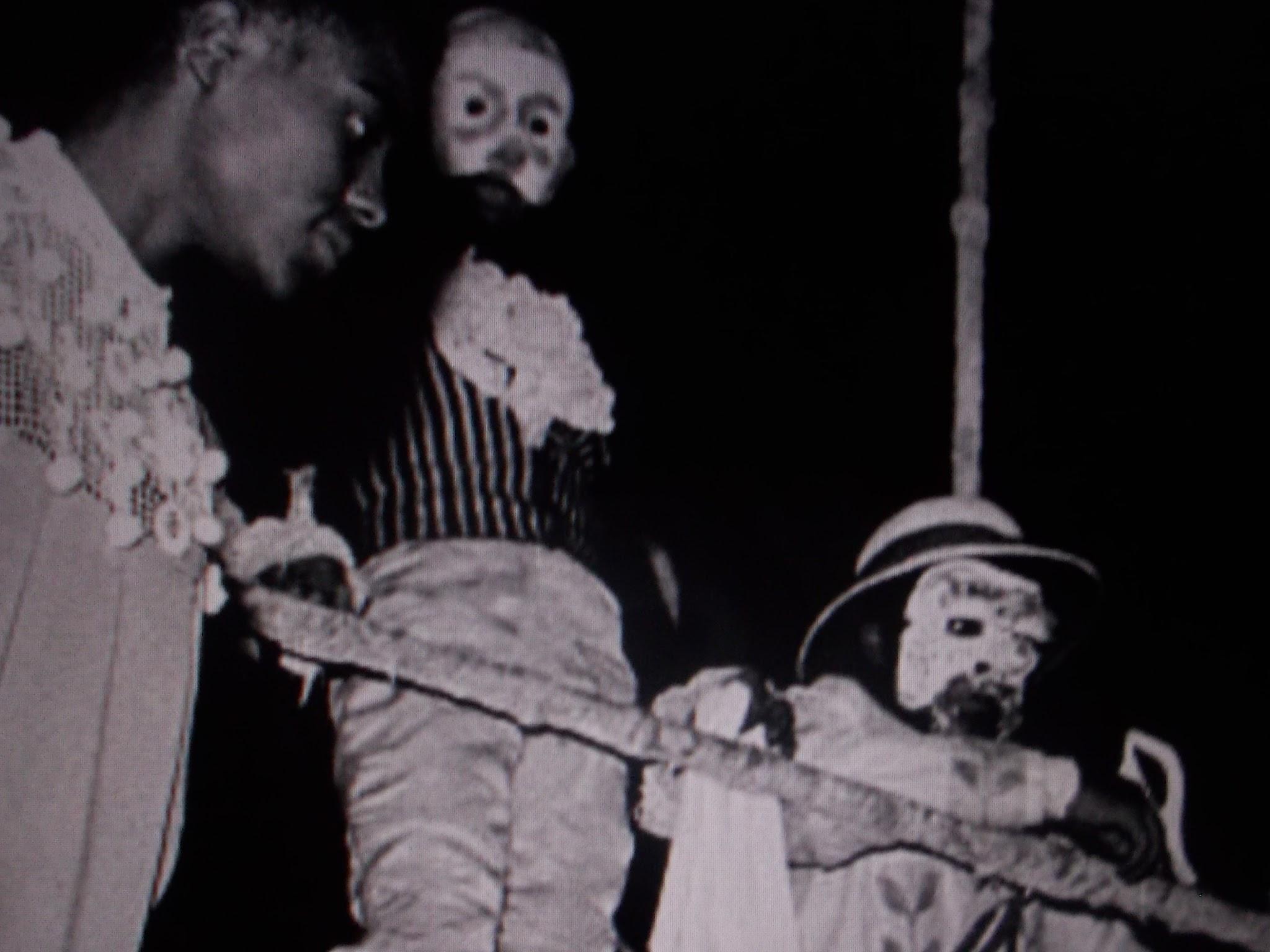
(Photograph taken from Jean Genet’s stage play “The Blacks”)
On the 6th December 1961 the French-Caribbean writer and psychiatrist Frantz Fanon died. He was just 36 years old and had been suffering from leukaemia. In his mercilessly short life he nonetheless managed to garner immense acclaim, both in his professional life and in his literary career. His lived experience as a black Frenchman allowed him a unique insight into the psychological effects of colonialism, and conversely the enduring mental struggles involved in decolonisation.
However he observed a more profound disturbance in his patients, a consequence of the politics and culture of France, and the French attitudes to the lands that they had colonised. In his seminal book “Black Skin, White Masks” he details the process, stating that,
“All colonised people…whose local cultural originality has been committed to the grave-position themselves to the civilising language”.
Fanon explained that the demotic, vernacular idioms spoken in the Caribbean were perceived as inferior to the official, formal language of the colonisers. The notions of superiority and inferiority in terms of race are entirely culturally determined.
Racial stereotypes are driven by cultural attitudes. The old idea of biological essentialism has been debunked as unscientific. Unfortunately it is a concept which continues to resonate and reverberate and also deepen and complicate the dilemmas of our contemporary world. The crude binary of “black” versus “white” denies people individual agency and traps people into confining and stifling roles. It promotes segregation rather than inclusion, uniformity rather than diversity and far from liberating continues to oppress people.
Fanon’s work has been reinterpreted in modern times by bad actors. Those who quote him fail to acknowledge the historical context in his writing, the years immediately after World War Two when a post-imperial world had not yet been redrawn. It is therefore completely disingenuous to cite his work in relation to the conflict in Israel-Palestine.
Fanon was vehemently opposed to the notion of an ethnostate which is more or less the goal of the Hamas terrorists who seek a purely Arab state cleansed of Jews. Israel, in contrast, does not object to the self determination of its Arab neighbours, it merely seeks to maintain a safe haven for Jews from all over the world to live in peace. Contrary to the prejudices of left wing activists, Zionism is not a racist or a nationalist ideology it is solely a religious philosophy.
Fanon observed that ingrained attitudes affected behaviour in a profound way, people felt they were perennial victims. This perception, that fixed people into the mode of the vanquished left them demoralised and silenced. Consequently the culture of control and manipulation simply perpetuated. It was a process that infantilised subjugated people.
Fanon’s philosophical arguments for decolonisation are far more nuanced and subtle than the angry polemicists who continue to misquote and misrepresent him. He ultimately believed in freedom from the prejudices that prevented people from achieving their potential.